

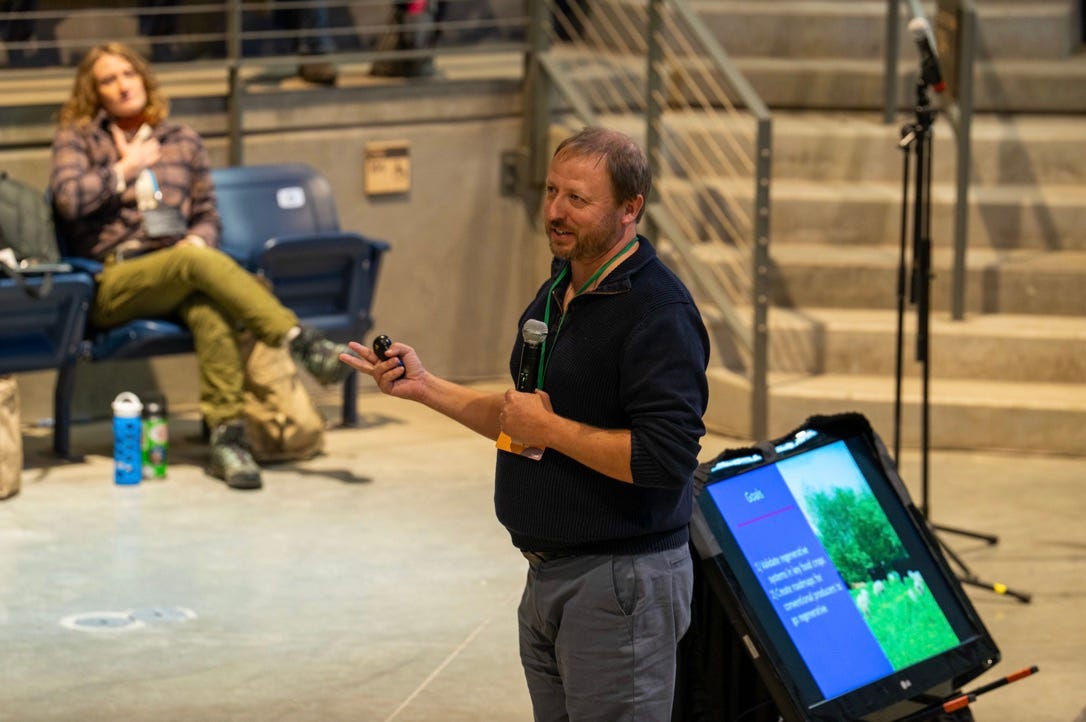
I recently wrote a piece here titled: Two ‘Regen’ Farmers Walk Into An Oval Office Debate Blind-Sided – And exit with the ‘most support we’ve ever had’. Those two farmers are legends. Will Harris from White Oak Pastures in Georgia, and my guest in this week’s podcast, former star USDA scientist turned whistleblower, now farmer and independent researcher in South Dakota, Dr Jonathan Lundgren.
Lundgren’s story is the stuff of blockbuster films – kind of like the Michael Lewis stories that inspired The Big Short and Moneyball. As a gun researcher with the USDA, he came to find deep concerns with chemical use in agriculture, only to later find deeper concerns with the political suppression of that research.
This is another story, of many I hear on the podcast, of someone at the top of their game, realising it’s the wrong game, and changing it. For Dr Lundgren, it was actually while receiving a distinguished award from another President that it hit him, ‘playing by the rules of the game wasn’t going to change how we produce food.’
Profound upheaval ensued. He quit his job and began planning what became a successfully crowdfunded farm and research foundation, propelled by a vision to transform food systems.
Just the other day, Blue Dasher Farm and Ecdysis Foundation celebrated their 10th birthdays, and a brewing paradigm change in food, farming and the health of people and planet.
And the Foundation’s 1000 Farms initiative, whose extraordinary findings proved pivotal to the Executive Order that emerged from the Oval Office that day, is believed to be the largest database of regenerative food systems in the world. And now it’s going global, including to Australia, still without any cost to farmers, or for that matter, to the rest of us.
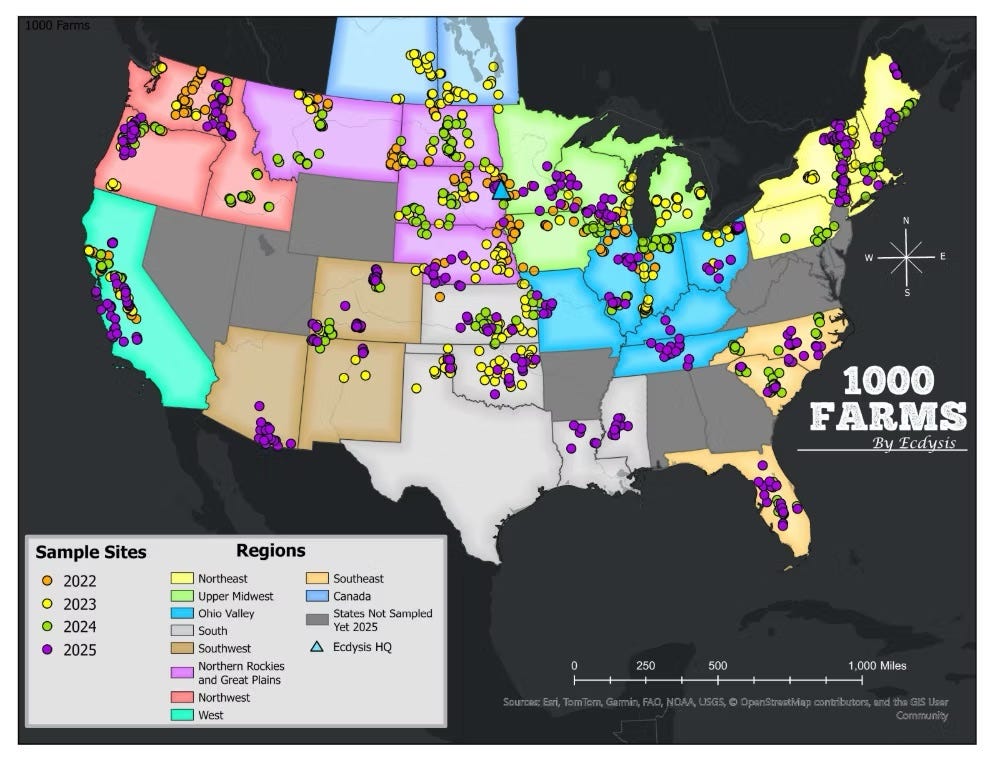
In reality, over 2,000 farms have been visited in the last 5 years, continent wide. And of all the findings the Ecdysis Foundation has turned up in that time, this is the high stakes summary that Dr Lundgren let rip in that pivotal Oval Office showdown:
Mr. President, the most striking data we have generated from our work is that row croppers in the U.S. have twice the asthma rates, 3 times the clinical depression, 3 times the cancer rate, and a 2,600 fold increase in Parkinson’s rates compared to the rest of society. We are killing our farmers.
But regenerative agriculture is a huge win for farmers. 90% of regenerative row crop farmers have abandoned all insecticides and fertilizers. Two-thirds have abandoned all synthetic fertilizers and herbicides.
The protein content of the wheat produced is twice as high as conventional wheat tested. Regenerative wheat yields are equivalent to national averages, and the profit potential is higher. This is the answer that American farmers have been looking for.”
And from my decade running the podcast, and an increasing number of reports, this is far from limited to American farmers, and eaters.
Regenerative agriculture, as Dr Lundgren relayed to me, addresses “water issues, both flooding and desertification. It increases nutrition of food. It improves the wellness, the physical mental wellness of farmers. It reduces agri-pollution, which is rampant right now and causing all kinds of issues.”
Farmers fear this weedkiller made them sick. Why hasn’t Australia banned it?
That was the headline of a 7am Podcast a couple of months ago. The blurb read:
Parkinson’s is the fastest-growing neurological disorder in the world. And in some Australian farming communities, doctors are questioning why so many seem to be getting it. For years, some farmers and doctors have drawn a link to paraquat – a powerful weedkiller still used widely on Australian farms, despite being banned in more than 60 countries, including the UK, China and Brazil.
And paraquat is far from the only concern. Stacey Curcio is a highly respected naturopath and nutritionist working with rural and regional Australians, and deeply embedded in farming communities. She shared a paper last week titled Australia’s Blind Eye: Exploring the Nation’s Permissive Stance on Harmful Pesticides. She wrote:
An Australian paper published this year reveals that of the 45 pesticides used in high volumes across Australian agriculture, 60% are banned in the European Union, while a further 24% are banned in at least one other country and only 15% of the identified “high-use” pesticide products have international approval.
This starts to get hard to digest, doesn’t it?
It reminded me again of the horrific National Farmer Wellbeing Report released a few years ago by the National Farmers Federation and partners in Australia. Its follow up, released just last month, is even worse.
That 7am Podcast I mentioned above went on to say:
This month, Australia’s chemical regulator is expected to decide whether paraquat can keep being used here – after a review that’s been going on since 1997. Professor Wesley Thevathasan is one of about 50 neurologists who made submissions to that review, calling for paraquat to be banned. But he says the regulator has ignored them – as well as some of the strongest evidence linking exposure to the chemical to Parkinson’s.
Days after that podcast, the Australian Pesticides and Veterinary Medicines Authority (APVMA) decided not to ban paraquat, but rather to introduce ‘significant new restrictions’. Its statement read:
… the APVMA found the weight of evidence does not show that paraquat exposure through approved uses increases the risk of developing Parkinson’s disease.
Parkinson’s Australia and Pesticide Action Australia strongly condemned the decision, and are calling for it to be urgently reviewed and for government support to help farmers transition away from the chemical.
I met neurologist Professor David Blacker AM, who has Parkinson’s, at a recent meeting convened by 2025 Western Australians of the Year, regenerative farmers Dianne and Ian Haggerty. He says the data on paraquat is overwhelming:
Large scale studies have identified an association between paraquat and the incidence of Parkinson’s. Like myself, people who grew up on farms and live around places like golf courses that are using paraquat aren’t safe.
Parkinson’s Australia is leading a campaign for the banning of paraquat, including a petition with 20,000+ signatures so far.
Professor Thevathasan says the regulator hasn’t even been looking at significant recent epidemiological studies. And adds that the countries where paraquat has been banned are still farming fine.
When President Trump asked Dr Lundgren in the Oval Office, ‘but the farmers need these sprays, don’t they?’, Lundgren answered:
I am an entomologist, Mr. President. I have been in their fields. No, they do not need these sprays.
Changing the system
Dr Lundgren and I talked about the other common agricultural chemical attracting campaigns and lawsuits aplenty - glyphosate. Ultimately, he said:
It's awful what these things are. And they're hurting us, they're hurting so many people, and there's no accountability with it. But we can chase individual symptoms so many times and and we'll exhaust ourselves. Let's change the system. Let's fundamentally show farmers that you don't need herbicides. And then these companies, they don't have an answer for that.
I continue to hear from people attempting to do just that, that they need the data, the evidence for what’s come to be called regenerative agriculture. Without it, they find themselves road-blocked.
The Governor of Western Australia called for it at the recent RegenWA conference. A former Minister of Agriculture soon after that. And from Kachana Station in the Kimberley, to the Haggerty family out in the wheatbelt, this is what they say is holding the transition and innovation back.
So I called this week’s podcast ‘You Want Evidence for Regen Ag? Here It Is’. It opens with this from Dr Lundgren:
We've got hard data. This became the largest database of regenerative food systems in existence. It's the third largest bio-inventory ever conducted by humans. And the data is like, what these farmers, I mean what they've developed is real. We're not making this up. It's true, it's scalable, it's transferable. This is the answer that we've been looking for.
Dr Lundgren and the 1,000 Farms initiative will be rolling out more of their findings at Climate Week (where the Haggerty’s will also be present), and will be visiting Australia next month. Australian farmers are invited to express interest in being included in its research program here.
And for the rest of us, families, schools, clubs, communities, businesses, hospitals, peak bodies, regulators, and all us eaters, it’s becoming clear, it’s not just the farmers we’re killing. Farming that breeds health, biodiversity, a stable climate, and even wonder and joy, is possible. And we can prove it.
It was so good to listen to the full interview with Brian - to hear his slow, considered answers - and some of the heartbreaking moments he shared. And now to know that the research is in and it’s good news. Thanks AJ!
I've been listening to your podcast for a long while now! Lovely to see you hear on Substack.
I do hope a similar 1000 Farms research is being done in Australia- so that the excuse of "It works in the US, it won't work here" isn't possible! 😉
I'm sure Brian Wehlburg can steer you towards many regenerative operations in Australia- maybe even Rachel Ward's land....